




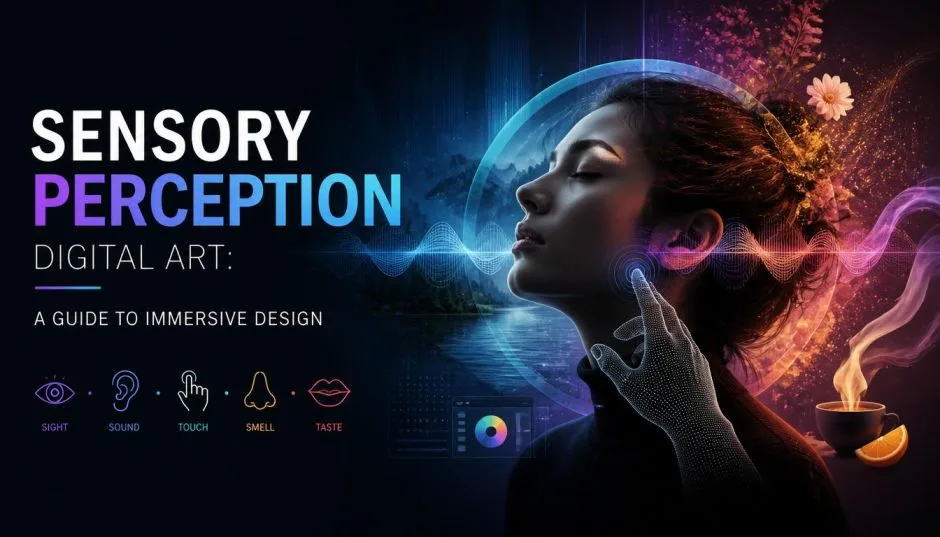
I walked into a gallery last month and stood in front of a screen. Nothing was there. Just static. Then I moved my hand. The pixels followed. They shifted like water. They responded to my breath.
That was my first real encounter with sensory perception digital art. It changed how I think about design. You are not just looking at something. You are feeling it. The art reacts to you. You react back. It is a conversation.
What Is Sensory Perception Digital Art?
Let me break this down simply. Sensory perception digital art uses technology to engage your senses. Not just sight. Hearing. Touch. Sometimes even smell and taste. The goal is immersion. You become part of the artwork.
Read Also: Why Scrapbook Style Design is Dominating 2026 Creative Trends?
Traditional art is passive. You stand and look. The painting does not change. The sculpture does not move. Digital art flips that. It responds to your presence. Your gestures. Your voice.
Think of it this way. A painting has texture you can see but not touch. Digital art creates texture you can feel through sound and movement. It is a shift from matter to behavior. What was once a physical imprint becomes an active phenomenon. Texture no longer sits on a surface. It occurs. It happens in real time.
The Fundamentals: Elements and Principles of Design
To understand sensory perception digital art, you need to know the building blocks. These are the elements and principles of design. They apply whether you are painting on canvas or coding in Python.
The elements of design are the tools. Think of them as ingredients. Point. Line. Shape. Form. Color. Value. Texture. Space.
The principles of design are how you use those tools. Balance. Emphasis. Movement. Pattern. Repetition. Proportion. Rhythm. Variety. Unity.
Here is the key. In traditional art, texture is tactile. You can feel it. In digital art, texture becomes visual and auditory. Algorithms create patterns that mimic natural phenomena.
Perlin noise is a good example. It draws from organic patterns and translates them into digital surfaces. The result looks like something you could touch. But you cannot. That is the tension.
How Sensory Perception Works in Digital Art?
Multisensory theory goes back to the 1970s. Psychologist Albert Mehrabian found that communication involves multiple channels. Words matter. But so do visuals and sounds. In face-to-face communication, 7% is verbal. 38% is auditory. 55% is visual.
You Must Also Like: Light Gray Paint Colors: Trending Shades for Modern Homes
Digital art applies this idea. It combines sensory channels. You see the colors. You hear the sounds. You feel the vibrations through haptic feedback. Sometimes you even smell scents released by the installation.
I experienced this at a museum last year. There was a room with motion sensors. As I walked, the projections shifted. The sound changed based on my speed. Slow walking gave me ambient tones. Fast walking triggered percussion. I was not just watching. I was making the music with my body.
That is the goal of multi-modal digital art. To integrate information through multiple sensory channels. It provides a complete immersive experience. Your brain processes everything together. That is why it feels so real.
The Role of Texture in Digital Art
Texture is crucial in sensory perception digital art. It bridges the gap between physical and virtual.
In traditional art, texture results from gesture. Think of Antoni Tàpies. He used impasto techniques. Thick paint. Rough surfaces. The grain and imperfections are imprints of a process. You can see the history.
Digital texture is different. It operates in real time. It modulates and reacts to stimuli. Sound. Data. Movement. What was once a physical imprint becomes behavior. The surface is no longer fixed. It evolves.
Artists like Ryoichi Kurokawa and Joanie Lemercier explore this expanded state. Light acts as malleable matter. Texture becomes an ephemeral architecture of time. Chance is embedded in the system. Each execution is unique. Unrepeatable.
Key Examples of Sensory Perception Digital Art
Let me give you real examples. These are not hypothetical. These exist. I have studied them.
Jin Ling Tu at Deji Art Museum in Nanjing. This is a large-scale interactive installation. It transforms a Qing Dynasty painting into digital art. Visitors wear positioning bracelets. They create personal images in the canvas. They can follow and interact with scene elements. You are inside the painting. Not just looking at it. The multi-modal interaction connects visual, auditory, and body language.
Hakanai by Adrien M & Claire B. This is stage art. It combines projection mapping, CGI, and sensors. Dancers move. The visuals respond. Real-time animation based on physical motion. The audience is invited to interact afterward. You can play with the light and shadow effects. The experience is multi-sensory. Visual. Auditory. Tactile.
Murmur by Chevalvert, 2Roqs, Polygraphik, and Splank. This is an architectural prosthesis. A tube collects sound from the audience. Light patterns respond on the wall. Sound waves become visual art. You speak. The wall reacts. Immediate feedback. That is the power of sensory perception digital art.
Why Experience Matters in Digital Art?
A 2017 study published in IEEE explored this. Researchers looked at the significance of physical experience and materiality in creative digital art. The findings were clear. Memory of lived experience informs creative cognition. Physical engagement with the world enables emotional expression.
Hand use and touch stimulate novel ideas. They help practitioners break from fixated thinking. Digital tools often lack interfaces that facilitate this translation. The physical and the virtual still have a gap.
I see this in my own work. When I sketch by hand, ideas flow differently. The resistance of the paper. The scratch of the pencil. Digital tools are smoother. More efficient. But they lack that friction. That friction is where creativity sparks.
Sensory perception digital art tries to bring that friction back. Not through paper. Through feedback. The art pushes back. It responds. That creates a loop. A conversation.
The Error Aesthetic: Glitch as Texture
Not all digital art aims for perfection. Some artists embrace error. Glitch art treats the mistake as creative material.
Rosa Menkman is a key figure. She calls the glitch a "wonderful disruption." It opens new possibilities for meaning. Her work exposes the inner architecture of code. The glitch becomes a texture of electronic communication.
Phillip Stearns and Sabato Visconti take this further. They transpose glitch into textile or photographic prints. Digital distortion returns to matter. A tactile return of error.
Andrew Benson works with shaders and digital distortions. His images fluctuate and disintegrate. They reflect on the fragility of the visual sign. Each glitch is a temporal layer. A vibration that reveals the machine's pulse.
This is relevant for sensory perception digital art. The error becomes sensory. You see the disruption. You hear the static. You feel the imperfection. It is not a bug. It is a feature.
How to Experience Sensory Perception Digital Art?
You do not need to be an artist to appreciate this. You just need to show up.
Visit interactive exhibitions. Museums and galleries are hosting more digital art. Check your local listings. Go with an open mind. Do not just stand there. Move. Speak. Touch if allowed. The art responds to your action.
Attend audiovisual performances. VJing and live cinema are growing. Artists like Pedro Maia blend 16mm film with digital manipulation. His work extends material cinema into hybrid space. Texture becomes time revealed. Memory in motion.
Engage with generative art. Platforms like Art Blocks host algorithmic art. Each piece is unique. You can collect digital art that changes over time. William Mapan is a good starting point. His work uses generative algorithms. The visual density evokes pictorial matter. Noise and modulation create landscapes that feel atmospheric and tactile.
Common Mistakes and How to Avoid Them
I have made these errors. Learn from me.
Thinking it is passive. Digital art is not a painting. You need to participate. If you just stand there, you miss the point. Move. Interact. The art needs your input.
Ignoring the sound. Sound is half the experience. Put on headphones if provided. Pay attention to the audio. It is not background. It is integral.
Rushing through. Each digital artwork is different. Each execution is unrepeatable. Take your time. Stay for multiple cycles. The art evolves.
Expecting the same experience twice. Sensory perception digital art is ephemeral. It changes. That is the beauty. You are there for a unique moment.
The Future of Sensory Perception Digital Art
The field is evolving fast. Multi-modal theory is expanding. Researchers are looking beyond sight and sound. Taste and smell are next.
Digital art should not overemphasize technology. User experience matters. Human behavior and perception must remain the foundation. Technology is a tool. Not the goal.
Artificial intelligence and virtual reality are joining the mix. New technologies will create new forms. But the core stays the same. The art must move you. Literally and emotionally.
The Final Thoughts
Sensory perception digital art is not a gimmick. It is a shift in how we experience creativity. The art responds. You respond back. That dialogue is what makes it powerful.
Go find an exhibition. Move through it. Let the pixels follow you. Listen to the sound. Feel the vibration. That is where the magic lives. Not on the canvas. Not in the code. In the space between you and the art.