




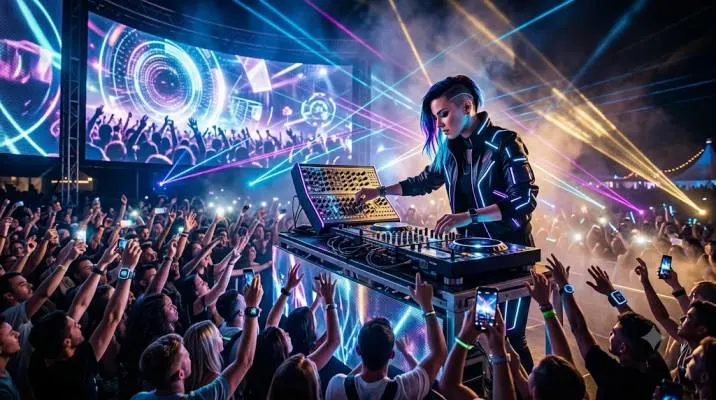
How Electronic Music Is Shaping Pop Culture in 2026? I was at a festival last summer. The main stage was packed. The artist was 2hollis, a young electronic producer from LA. The crowd was a mix of ravers, hip-hop heads, and indie kids. They were all jumping to the same beat.
That moment made me realize something. The walls between genres are crumbling. Electronic music is no longer a niche. It is the mainstream. To understand what is the impact of electro music on pop culture, you need to look at the festival lineups, the charts, and how artists are breaking the old rules of genre.
How Electronic Music Is Shaping Pop Culture in 2026?
Pop Culture Has a Genre Problem
If you ask people what kind of music they like, they used to say "rock" or "pop" or "hip-hop." In 2026, that answer does not work anymore. Music in 2026 has a problem.
Read Also: The Art of Cinematic Framing: How Directors Tell Stories Without Words?
Over the past six months, a new generation of broadly electronic artists has moved closer to the mainstream: Underscores, Ninajirachi, and 2hollis have become some of the biggest names in music. But nobody seems sure how to label them. Are they electroclash? Electronic pop? Rage? The truth is, they are all of the above.
What we are seeing is an explosion of fusion genres. Pop, electro, and rock have become one big playground where everything mixes . The old boxes do not fit. And that is exactly the point.
Electro Music Is Blurring the Lines of Genre
A 2026 report from RTBF describes this as "musical hybridization." It is not new. Rock 'n' roll itself was a mix of blues and country. But now, hybridization has become the rule rather than the exception. Rare are the songs that stay neatly in one box.
Take the Eurovision Song Contest as an example. In 2023, Finland's Käärijä performed "Cha Cha Cha." It was a genre-pivot in a single song. It started with aggressive, industrial distortion. Then it modulated into a sparkling, neon-drenched hyperpop melody. The track simulated the transition from a sweat-soaked warehouse rave to a euphoric dancefloor .
The staging matched: Käärijä emerged in a toxic-green bolero jacket, bare-chested, trapped in a shadowy wooden box. When the genre shifted, the stage exploded into blinding neon pink. Ballroom dancers broke free from the shadows . This was not just a song. It was a visual and sonic statement.
Then came Croatia's Baby Lasagna in 2024. His track "Rim Tim Tagi Dim" was a masterclass in aggressive, stadium-sized techno-rock. It was built on a loop-based synthesizer riff that mimicked a heavy metal guitar chug, locked to a relentless techno beat.
The sub-bass was so heavy it acted as a physical engine . Visually, he mixed industrial techno with traditional Balkan folklore. He wore oversized historical white puff-sleeves with neon-pink strobe lace. He looked like an agrarian peasant who had wandered into a hardcore rave in Berlin . This kind of fusion is now the standard.
Even Norway's Alessandra in 2023 showed the shift. Her song "Queen of the Kings" was a hyper-pop-opera assault. It bypassed the traditional slow build and delivered an unrelenting, peak-time festival anthem.
The vocal frequencies were gated and compressed so they cut through like a digital saw-wave synth . The track ditched subtle chord progressions for pure, vertical energy. She looked like a high-fantasy video game boss . This is what pop looks like now.
New Electronic Music Genres Are Emerging Constantly
The constant evolution means new electronic music genres are being named all the time. Some stick. Some do not. But the process itself shows how dynamic the scene is.
Sleazepop
In 2025, a new term started appearing online: Sleazepop. It was coined on an Instagram fanpage and quickly moved to Reddit. The community describes it as "electronic music that takes a lot of inspiration from rap and a bit of rock – it's like rap-inspired-electroclash" .
It is messy, gritty, and physical. Unlike hyperpop, which was often glossy and cartoonish, sleazepop leans into something more aggressive. Artists like 2hollis, Underscores, and fakemink are part of this movement.
It is primarily an LA movement, tracing back to The Hellp's scuzzy, dance-punk take on indie sleaze . The visual style is a return to hipster aesthetics: flash-lit parties, skinny jeans, and rockstar posturing.
Transplex
On the more academic side, a new genre called TRANSPLEX was formally defined in 2025 by Akihisa Yorozu. It integrates the structural clarity and euphoric build-ups of Trance with the fragmentary timbral dynamism of Complextro.
It is grounded in information theory, cognitive neuroscience, and music psychology, and is defined as a genre constrained by an "optimal complexity zone," balancing predictability and novelty . This shows that even within electronic music, people are trying to create new, structured subgenres.
Ambient/Experimental and Downtempo
Even major platforms are adapting. Beatport, the global leader in music for DJs, recently added Ambient/Experimental as a standalone genre and reclassified Downtempo as its own category.
This reflects the rising popularity of atmospheric, immersive soundscapes and slow-groove rhythms . Beatport's Vice President of Global Curation said these genres offer artists a space for deep sonic exploration and provide listeners with immersive, boundary-pushing experiences . This is not just about music. It is about the experience.
The Culture Shift: A New Mainstream
The biggest impact of electro music on pop culture is the cultural shift in who is a "rock star." In 2026, electronic artists are increasingly occupying the role of rock stars on main festival stages. Hip-hop kids and electronic kids have never had so much in common.
You Must Also Like:
A strange convergence can be seen in how emerging rap acts like Slayr and fakemink are booked for the same lineups as queer and trans electronic artists like Jane Remover and Underscores . The underground scene has become a melting pot.
The decline of traditional genre boundaries is also evident in the sound of mainstream pop. Artists like Angèle with "What You Want" with Justice make it hard to say if a track is "purely" electro .
Rosalía's album "Lux" blurs the line between pop and classical. And BLACKPINK's "JUMP" mixes rock guitar chords, EDM, trap, pop, and hard techno in a single song .
How to Navigate This New Music World?
If you are trying to figure out what to listen to, do not rely on genre labels. They do not work anymore. Here is my honest advice:
Follow artists, not genres. If you like an artist, check out who they collaborate with. The web of connections is how you find new music.
Use platforms that embrace fusion. Beatport's new categories are a good start. They allow for more precise classification . But even then, expect the music to cross lines.
Do not be ashamed of your taste. "Guilty pleasure" is a dead phrase. The simple, overwhelming joys of pop and electro are being embraced unapologetically . If it makes you move, it is good music.
Pay attention to the visual side. In 2026, the music and the visuals are inseparable. The staging, the outfits, the lighting—they are all part of the art. A track is not just a track. It is a whole world.
Be open to experiment. The ethos of 2026 is experimentation. The "pourquoi pas?" attitude has replaced doubt . Artists are trying weird things. And it works. If you only stick to what you know, you will miss out on the next big sound.