



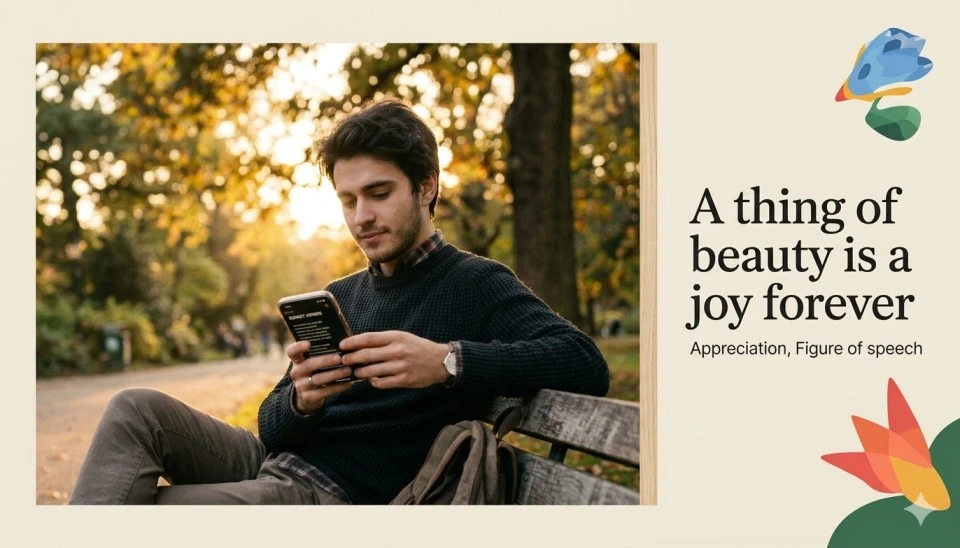
My English teacher asked me a question in 10th grade. What does Keats mean? I had no answer. I copied from the guidebook. I passed the test. I forgot the poem. Fifteen years later, I sat in a hospital waiting room.
My father was inside for a routine checkup. The clock on the wall ticked slowly. A plastic plant sat in the corner. Nothing was beautiful. I pulled out my phone. I searched for something to read. Keats came up.
A thing of beauty is a joy forever. I read the whole poem that afternoon. Not for a grade. Not for homework. Because I needed something to hold onto. That is when I finally understood.
Let me give you a proper a thing of beauty is a joy forever poem appreciation. No textbook language. No fancy terms you have to look up. Just what Keats actually meant and why it still matters.
What Does "A Thing of Beauty is a Joy Forever" Actually Mean?
Most people get this line wrong. They think Keats talks about pretty objects. A diamond ring. A luxury car. A perfect face. Read the full poem. He lists the sun, the moon, trees, daffodils, and clear streams.
Read Also: Books If You Liked Wuthering Heights | Classic Reads
Ordinary things. Free things. Things you do not need money to see. He also talks about "an endless fountain of immortal drink. Here is what he means.
Beauty is not something you own. Beauty is something you drink. It goes inside your body. It becomes part of you. It stays there forever. I tested this idea last summer.
Every morning for thirty days, I found one small beautiful thing. A bird on a fence. The way dust floated in sunlight. My neighbor's cat stretching on a wall.
I did not photograph any of them. I just looked. By day twenty, I noticed a change. Bad news did not hit me as hard. Traffic did not make me angry. Something had shifted inside.
That is the joy Keats talks about. Not happiness that comes and goes. A steady hum in your chest that stays.
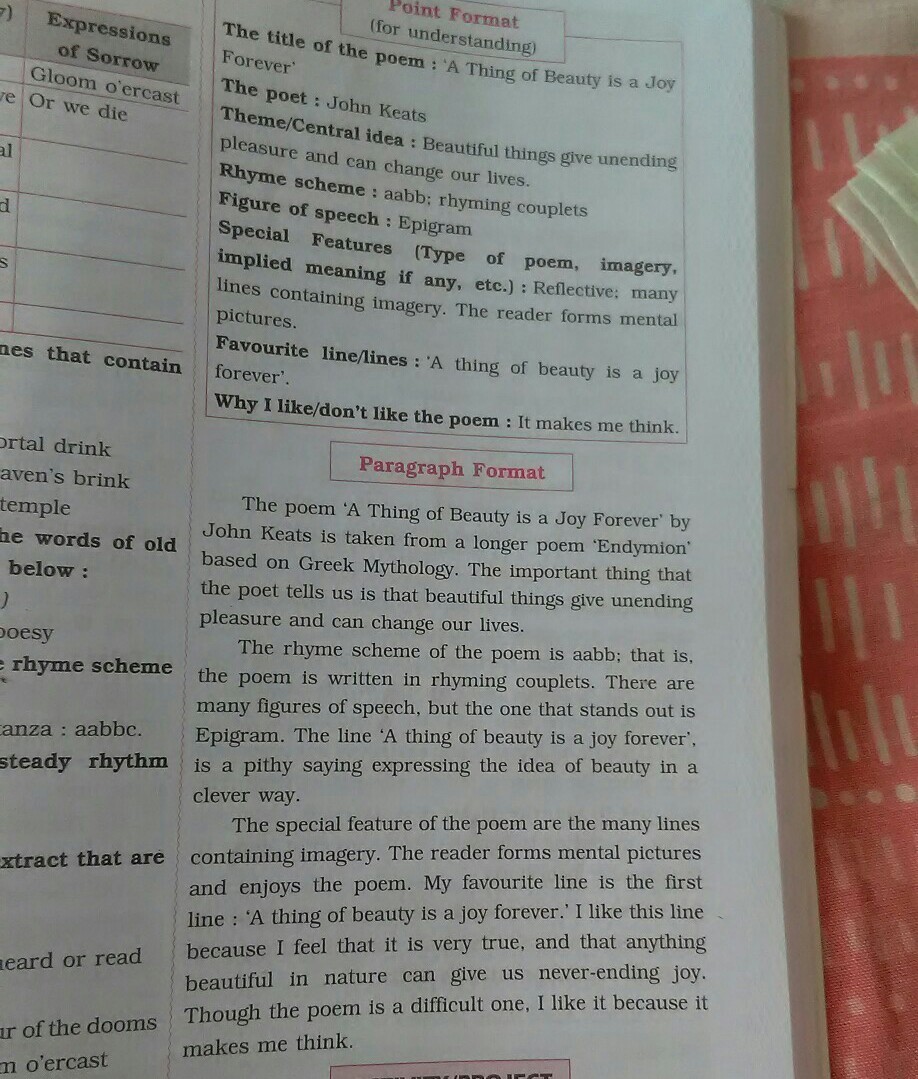
The Figure of Speech Keats Uses (Simple Explanation)
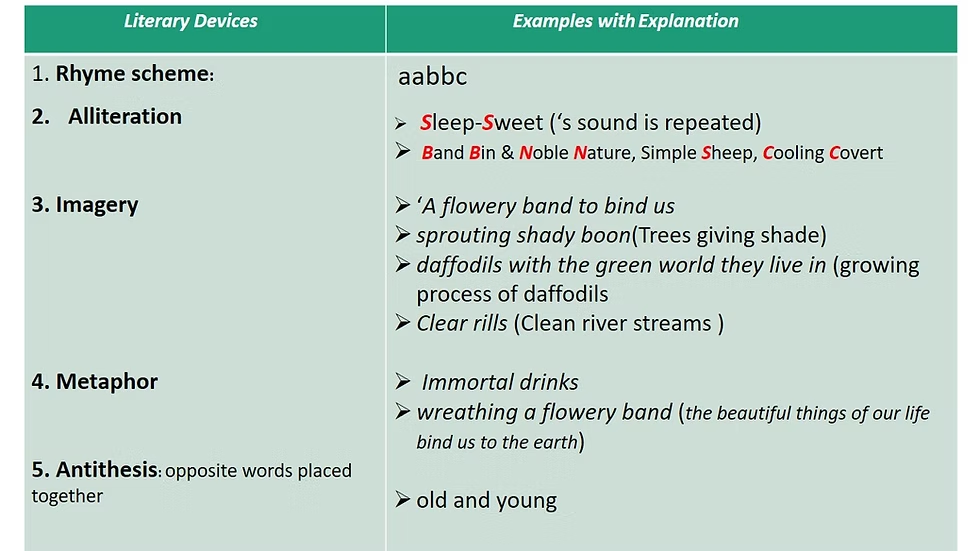
You asked about figures of speech. Here is the main one. Personification.
Keats gives beauty human qualities. Beauty does not just exist. Beauty "keeps" us. Beauty "binds" us. Beauty "pours" joy into our souls.
I never understood personification in school. My teacher said, "Giving human traits to objects." That felt like a definition without a heartbeat. Now I see it differently.
Keats needed beauty to act like a person because he felt so alone. His brother Tom had died from tuberculosis. Keats knew he had the same disease. He was coughing blood. He was broke. He was scared.
He could not count on people staying. Everyone he loved kept leaving. So he turned beauty into a friend. A friend that never dies. A friend that never moves away.
That is not just a figure of speech. That is a dying man building a lifeline.
A Thing of Beauty is a Joy Forever Poem Appreciation Meaning (Line by Line)
Lines 1 to 10: The Main Idea
Keats opens with his famous line. Then he says beauty "increases" over time. It does not fade. It grows stronger. Think about a song you loved at sixteen. Listen to it now. It feels different, right? Deeper. Richer. That is what Keats means.
Lines 11 to 25: The Dark Part
Here Keats admits life is hard. He uses words like "gloom," "dark spirits," and "malice." He says we feel "despondence" (hopelessness) and "inhuman dearth" (empty loneliness).
I love this part because Keats does not pretend. He does not say "cheer up." He says "yes, it is bad. I see you."
Lines 26 to 42: The Healing
Now Keats offers the cure. Nature. The sun. The moon. Trees. Daffodils. Clear streams. He says these things "pour" joy into our souls. Notice the verb. Pour. Not give. Not offer. Pour. Like water into an empty glass.
Lines 43 to the End: The Fountain
Keats returns to the fountain image. Beauty flows endlessly. You can drink whenever you need it. There is no limit. There is no expiry date. I keep this image in my head on bad days. A fountain in the middle of a desert. Always running. Always waiting.
Why Keats Wrote This Poem (The Sad Backstory)?
Nobody teaches you this in school. John Keats trained as a surgeon. He worked in a London hospital. He saw children die. He saw infected wounds. He saw bodies that would not heal.
He gave up medicine for poetry. His family called him foolish.
You Must Also Like: How to Read Libby Books on Kindle?
Then his brother died. Then he started coughing blood. Then the girl he loved moved away because she was told he would not live. Most people at twenty-three worry about jobs and rent. Keats worried about how much time he had left.
That is why the poem matters. A healthy person writing about joy is nice. A dying person writing about joy is a miracle. Keats died three years after publishing this poem. He was twenty-five.
Appreciation of Poem "The Will to Win" (Quick Comparison)
It helped for about twenty minutes. Then the nerves came back. Here is the difference. Braley tells you to fight. Keats tells you to rest. Braley is for the morning when you need energy. Keats is for the night when you have nothing left.
Both have value. But Keats stays with you longer. Because life is not always a fight. Sometimes life is just heavy. You cannot fight heavy. You can only rest in something beautiful.
The Height of the Ridiculous Appreciation
But sorrow? Longing? The search for peace? Those never date. Keats wrote about things every human feels in every century. That is why we still read Keats. That is why your teacher assigned this poem.
How I Used This Poem During a Hard Week?
Last year, I lost a freelance contract. Sixty percent of my income disappeared overnight. I spent three days panicking. I checked my bank account fifteen times a day. I could not sleep. On day four, I remembered Keats.
None of that fixed my money problem. But for twenty minutes, I stopped drowning. That is what Keats offers. Not solutions. Breathing room. I found new work two weeks later.
I do not know if the park helped.
A Thing of Beauty is a Joy Forever Poem Appreciation for Students
If you are a student reading this for homework, here is what your teacher actually wants. Do not just list rhyme schemes. Do not just count syllables. Answer these three questions in your own words.
Question 1: What solution does Keats offer?
Answer: Nature. The sun, moon, trees, flowers, and streams. Looking at beautiful things heals us.
Write those three answers in simple sentences. Add one example from your own life. You will get an A. More importantly, you will actually understand the poem.
Four Ways to Live This Poem (No Poetry Degree Needed)
You do not need to memorize stanzas. You need to change how you see Tuesday afternoon.
One. The five-minute look.
Every day, spend five minutes looking at one thing. Not your phone. A real thing. A leaf. A coffee cup. A crack in the wall. Just look.
Two. The revisit rule.
Keats says beauty's joy increases with time. So revisit something you loved five years ago. A song. A place. A book. Notice how it feels different now.
Three. The dark acceptance.
Do not pretend sadness does not exist. Keats did not. Say out loud, "Today is hard. But the sky is still blue." Both things can be true.
Four. The fountain spot.
Find one place in your town that feels like a fountain. A park bench. A library corner. A coffee shop window. Go there when life feels dry.
The Line Everyone Misses (And Why It Matters)
Everyone quotes the first line. "A thing of beauty is a joy forever." But the second line is better. "Its loveliness increases." Think about that. Most things decrease. A new phone feels exciting for a week. Then it is just a phone.
A new shirt feels special for two wears. Then it is just cloth. But real beauty? It grows.
Final Thoughts
I do not read poetry often. Keats gave me that help. Not because he had answers. Because he had company. He said, "I see the darkness too. Look at this flower with me.
That is all any of us need sometimes. Someone to sit in the dark and point at something beautiful. Go find your fountain today.